

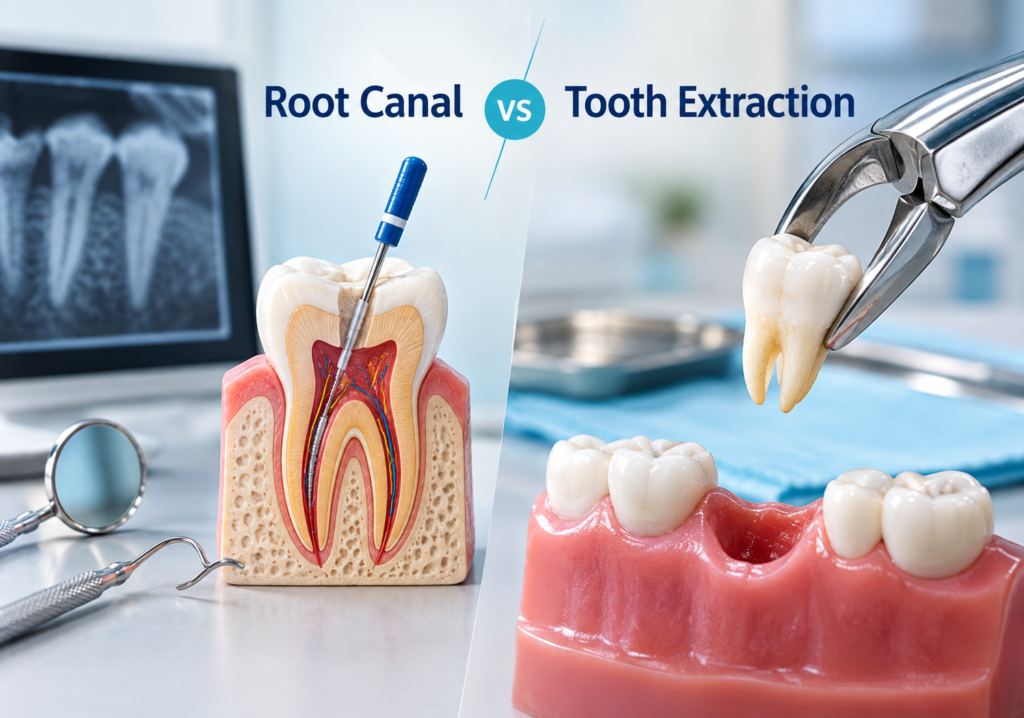
Losing a tooth to decay or infection forces a decision most people aren’t prepared for. When a dentist says the pulp is infected, the conversation almost always turns to root canal vs tooth extraction, and the two paths lead to very different outcomes for your bite, your budget, and your long-term oral health. This guide breaks down what each option really involves, so you can walk into that appointment with clear expectations rather than guesswork.
What Happens During a Root Canal
A root canal removes infected or inflamed pulp tissue from inside the tooth, cleans the canal, and seals it with a filling material. The outer tooth structure stays in place, which means you keep chewing with your natural enamel rather than an artificial replacement. Most patients need one to two visits, and a crown is usually placed afterward to protect the treated tooth from fracture.
What Happens During a Tooth Extraction
Extraction removes the entire tooth, root and all. It’s a shorter procedure than a root canal in most cases, and it immediately eliminates the source of pain or infection. But removing a tooth doesn’t end the story. The empty socket changes the mechanics of your bite and the shape of your jawbone over time.
Tooth Extraction Disadvantages You Should Weigh First
Before agreeing to pull a tooth, it helps to know exactly what you’re trading away. Some of the most common downsides of pulling a tooth include:
- Gradual bone loss in the jaw where the tooth used to sit
- Neighboring teeth drifting or tilting into the empty space
- Changes in bite alignment that can strain the jaw joint
- A visible gap if the missing tooth sits near the front
- Added cost and time for a replacement such as a bridge or implant
Research backs up the bone-loss concern specifically. A systematic review of post-extraction studies found horizontal bone loss of 29% to 63% and vertical bone loss of 11% to 22% within six months of a tooth being pulled, according to data published on PubMed. That kind of resorption can make a future implant harder to place without additional bone grafting.
Disadvantages of Tooth Extraction Beyond the Socket
These downsides of removing a tooth aren’t limited to what happens inside the jawbone. Everyday function can shift too:
Function and Comfort
- Chewing efficiency drops on the affected side, sometimes leading to overcompensating with the other side
- Opposing teeth may over-erupt into the gap if it stays unfilled for too long
- Speech can be affected temporarily when a front tooth is removed
Emotional and Practical Impact
- Many patients feel self-conscious about a visible gap, even from a back tooth
- Delaying a replacement often raises the eventual cost and complexity of treatment
None of this means extraction is always the wrong call. It simply means the decision deserves more thought than “just pull it.”
When a Root Canal Is Usually the Better Route
Dentists generally lean toward saving a natural tooth whenever the surrounding structure is healthy enough to support it. A root canal tends to make sense when:
- The tooth has enough healthy structure left to hold a crown
- The infection hasn’t spread into the surrounding bone
- The patient wants to avoid the cost and healing time of an implant
- Preserving natural bite feel and jawbone density matters long-term
A root canal specialist in Park Street can evaluate the extent of the infection with an X-ray and often tell you within one visit whether the tooth is worth saving.
When Extraction Becomes the Practical Choice
Extraction isn’t a last resort by default. Sometimes it’s genuinely the better clinical decision, particularly when:
- The tooth is fractured below the gum line with no structure left to restore
- Decay has destroyed too much of the tooth to support a filling or crown
- Advanced gum disease has already loosened the tooth in its socket
- Repeated root canal attempts on the same tooth have failed
Tooth Extraction vs Root Canal: Cost, Time, and Longevity Compared
- Cost: A root canal plus crown often costs more upfront, but extraction usually needs a follow-up implant or bridge, which raises the long-term total.
- Recovery: Extraction recovery is typically faster in the first week; a root canal causes milder discomfort but may need a second visit for the crown.
- Longevity: A well-treated tooth can last decades with normal care, while an extraction site can affect jawbone density for years if left unaddressed.
- Natural function: A root canal preserves your original bite feel and root sensation, while extraction removes both, even with an implant in place.
Getting the Right Diagnosis Before You Decide
Neither option should be chosen without an actual look at the tooth and the bone around it. An X-ray shows how much healthy structure remains and whether infection has spread past the root tip, details that change the entire conversation. If you’re weighing root canal vs tooth extraction for a tooth that’s currently hurting, a dentist in Park Street can examine it, walk you through both outcomes for your specific case, and help you avoid a decision you’ll regret later.
Research into treatment outcomes offers some reassurance here too. A long-term systematic review of root canal outcomes reported success rates between 68% and 85% under strict clinical criteria, according to a review indexed on NCBI. That’s a solid track record for a treatment aimed squarely at keeping your natural tooth in your mouth.
The Bottom Line
There’s no single right answer for every patient. It depends on how much healthy tooth structure remains, how far the infection has spread, and what you’re comfortable investing in for long-term oral health. What matters most is getting an honest, X-ray-backed evaluation before the decision gets made for you by a worsening infection.
Frequently Asked Questions
Is a root canal more painful than an extraction?
Not typically. Modern root canals are performed under local anesthesia and feel similar to getting a deep filling. Post-procedure soreness is usually milder than after an extraction.
Can a tooth be saved after a root canal fails?
Sometimes. A retreatment or a minor surgical procedure at the root tip, called an apicoectomy, can save the tooth in select cases. Otherwise, extraction becomes the next step.
How long does healing take after an extraction?
Basic socket healing takes about one to two weeks, but the surrounding bone continues remodeling for several months afterward.
Do I need to replace an extracted tooth right away?
It’s best not to wait too long. Delaying allows neighboring teeth to shift and jawbone to resorb, which can complicate a future implant or bridge.
Is root canal treatment permanent?
A properly treated and restored tooth can last a lifetime with the same care and regular checkups as any natural tooth.