

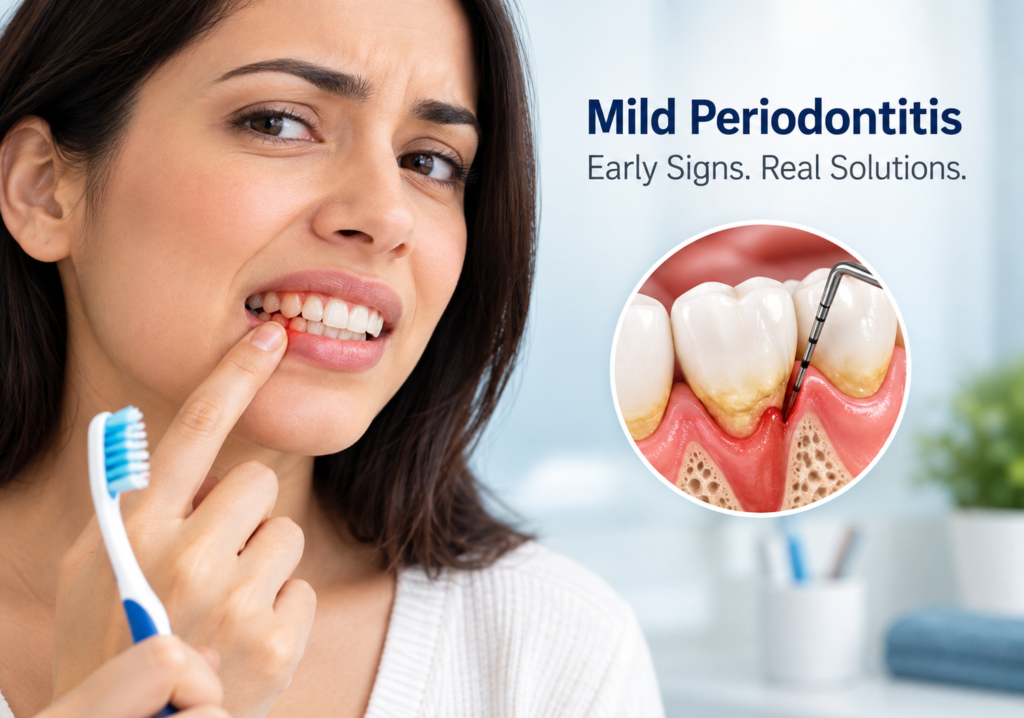
If your gums bleed a little every time you brush, it’s easy to shrug off. But that small warning sign can point to mild periodontitis, the first stage where bacteria have moved past the gumline and started affecting the bone that holds your teeth in place. It’s more common than most people realize; the CDC estimates that close to four in ten American adults over 30 have some level of periodontitis, and a large share of them have no idea until a dentist points it out during a routine exam.
The question most patients ask next is simple: once it starts, can it be undone? The answer depends on how far it has progressed, and mild periodontitis happens to be the stage where you still have real options.
What Is Mild Periodontitis?
Periodontitis is a chronic form of dental periodontal disease that develops when plaque bacteria are left to sit along and beneath the gumline for too long. Left untreated, gum inflammation (gingivitis) can eventually turn into periodontitis, a stage where the infection has started to break down the fibers and bone that anchor your teeth.
Dentists usually classify the disease in stages based on how much attachment loss has occurred:
- Mild (Stage I): Slight bone loss, with pockets forming around the tooth root
- Moderate (Stage II): More noticeable bone loss and deeper pockets
- Severe (Stage III/IV): Significant bone loss, loose teeth, and possible tooth loss
Mild periodontitis sits right at the tipping point. There’s already some damage, but not enough to be permanent for most people.
Symptoms of Mild Periodontitis You Shouldn’t Ignore
The early signs are subtle, which is exactly why so many cases go unnoticed for months or years. Watch for:
- Gums that bleed during brushing or flossing, even without hard pressure
- Slight puffiness or a dusky red color along the gumline instead of a healthy pink
- Breath that stays stale shortly after brushing
- Gums that appear to be pulling back slightly, making teeth look a touch longer
- Mild tenderness when chewing on one side
- Small pockets (around 1 to 2 mm of attachment loss) that your dentist can measure with a probe, even though you can’t feel them yourself
None of these on their own are alarming, but together they’re usually a sign your gums need attention sooner rather than later.
What Causes Mild Periodontitis?
At its root, this is a bacterial disease. Plaque that isn’t removed regularly hardens into tartar, which irritates the gums and eventually triggers the body’s own inflammatory response, the process that actually damages the supporting bone. Several factors make someone more likely to reach this stage:
- Inconsistent brushing and flossing habits
- Tartar buildup that hasn’t been professionally removed in a while
- Smoking or tobacco use, which restricts blood flow to the gums and slows healing
- Diabetes or other conditions that affect the body’s inflammatory response
- Hormonal shifts, such as pregnancy, that make gums more sensitive to plaque
- Crooked or crowded teeth that trap food and are harder to clean
- Certain medications that reduce saliva flow, since saliva naturally helps wash away bacteria
How to Cure Periodontal Gum Disease at the Mild Stage
Here’s the encouraging part. Because bone loss at this stage is minimal, dentists generally agree that mild periodontitis can be brought back under control, and in some cases the gum tissue heals close to its original state. This is different from advanced disease, where lost bone typically can’t be fully regenerated.
Professional Treatments Your Dentist May Recommend
- Scaling and root planing: a deep cleaning that removes plaque and tartar below the gumline, then smooths the root surface so bacteria have a harder time reattaching
- Antimicrobial rinse or localized antibiotic gel: placed directly into the pocket to reduce bacterial load
- Periodontal maintenance visits: typically every three to four months instead of the usual six, so the gums stay monitored while they recover
Daily Habits That Support Healing
- Brush twice a day with a soft-bristle brush, angling the bristles toward the gumline rather than straight across
- Floss once daily, and consider a water flosser if pockets make regular floss hard to maneuver
- Cut back on smoking, since it’s one of the biggest barriers to gum tissue repair
- Reduce sugary and processed foods, which feed the same bacteria driving the inflammation
- Keep every follow-up cleaning appointment, even once symptoms improve
From Mild to Advanced: Why Timing Matters
Periodontitis doesn’t stay still. Left alone, mild disease can progress to moderate and then severe stages, where bone loss becomes deep enough that teeth loosen or shift. At that point, treatment looks very different. Advanced periodontal disease treatment often involves flap surgery to access deeper tartar, bone grafting to rebuild lost support, or guided tissue regeneration, procedures aimed at slowing further damage rather than reversing it completely.
That’s the real value of catching things early. A round of deep cleaning and better home care at the mild stage is far simpler, less costly, and far more likely to fully resolve the problem than the surgical route needed once the disease advances.
When Should You See a Dentist?
If you’ve noticed any bleeding, puffiness, or gum recession that hasn’t gone away in a couple of weeks, it’s worth getting a periodontal charting done rather than waiting for pain to show up, since pain is usually a later symptom. A top dentist in Esplanade can measure pocket depth, check for early bone changes, and map out a treatment plan while the condition is still easy to manage.
Frequently Asked Questions
Is mild periodontitis reversible?
In most cases, yes. Because bone loss is minimal at this stage, professional cleaning combined with consistent home care can restore healthy gum attachment for many patients.
How long does it take to see improvement?
Most people notice less bleeding and swelling within two to four weeks of starting treatment, though full pocket healing can take a few months of consistent care.
Can mild periodontitis return after treatment?
Yes, if oral hygiene slips or maintenance visits are skipped. Periodontal disease is manageable long-term, not a one-time fix.
Is scaling and root planing painful?
Most patients feel only mild discomfort, and a local anesthetic is typically used to keep the deep cleaning comfortable.
Does gum disease affect anything beyond the mouth?
Research has linked untreated periodontal disease to increased inflammation elsewhere in the body, which is another reason dentists recommend treating it early rather than waiting.