

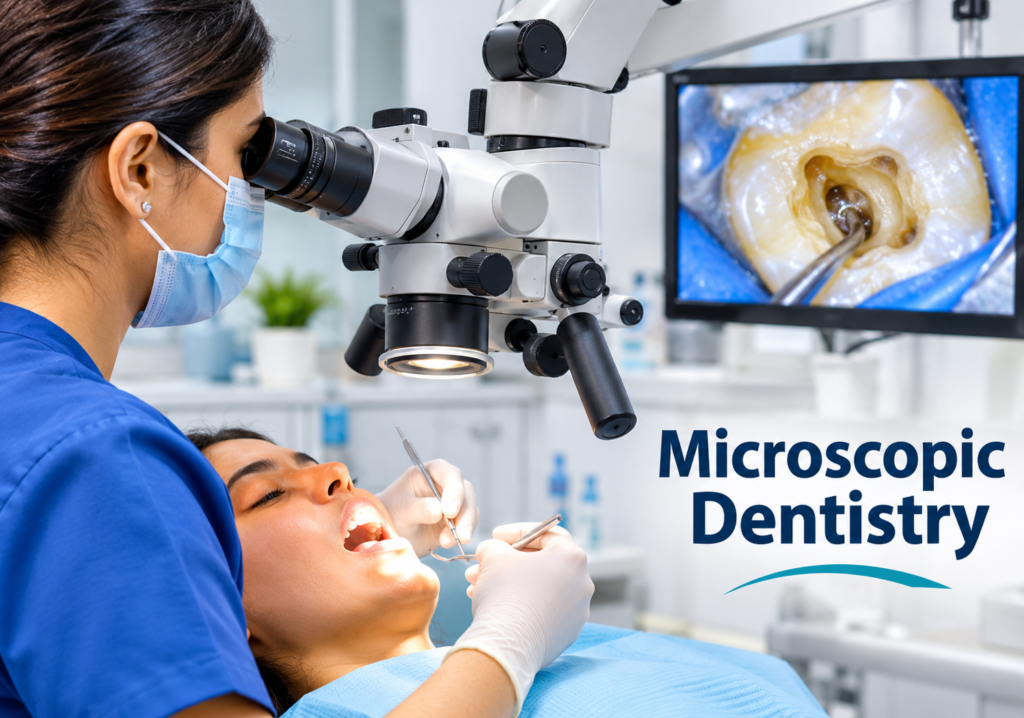
The tip of a root canal can be narrower than a strand of hair. Your dentist has to find it, clean it and seal it, often inside a molar right at the back of your mouth. Microscopic dentistry takes most of the guesswork out of that job. It means treating teeth under a dental operating microscope that magnifies the area many times over, so cracks, hidden canals and leftover decay become clearly visible.
If you’ve been told you need a root canal, a retreatment or a tricky filling, here’s what microscopic dentistry actually changes and whether it’s worth asking for.
Still feeling pain in a tooth that was treated before? Ask the team at Radix Dental Care whether microscopic dentistry suits your case. Book a consultation and we’ll take a proper look.
What Is Microscopic Dentistry?
Microscopic dentistry is dental treatment done while the dentist looks through an operating microscope instead of relying on the naked eye. Most dental microscopes magnify between roughly 3x and 25x. The light travels along the same line as the dentist’s view, so there are no shadows inside the tooth.
Surgeons have used the operating microscope in eye and ear surgery for decades. Dentistry came to it later, mainly through endodontics, the branch that treats the pulp and roots. Now the microscope in dentistry shows up in fillings, crowns and gum work too.
Naked eye, loupes or a dental microscope?
- The naked eye is fine for check-ups, cleaning and simple fillings.
- Loupes, the magnifying lenses fixed to a dentist’s glasses, usually work at 2.5x to 4x.
- A dental microscope goes much higher, has its own light source and can record video of the procedure.
How Does Microscopic Dentistry Work?
The chair and the routine feel familiar. What microscopic dentistry changes is how much the dentist can see at every step.
- Planning. Your dentist studies your dental X-rays to map the roots. An X-ray is a flat image, though, so the microscope confirms what’s really there once treatment starts.
- The tooth is isolated with a thin rubber sheet called a dental dam to keep it dry.
- The microscope is swung into place above your mouth. You won’t look into it. The dentist does.
- Fine instruments and ultrasonic tips do the work under high magnification.
- Many clinics save photos or short clips, so you can see the crack or canal that was found.
A case we see fairly often is a dull ache in an upper molar that had a root canal years ago. The X-ray looks acceptable. Under the microscope, there’s an extra canal that was never cleaned, sitting right beside one that was. Upper first molars are known for this hidden fourth canal, and it’s a common reason old root canals fail.
Microscopic Root Canal Treatment and Microscopic Endodontics
This is where microscopic dentistry earns its fee. Microscopic root canal treatment helps the dentist find calcified or curved canals, remove old filling material during retreatment and retrieve broken instrument fragments without drilling away healthy tooth. Wikipedia’s overview of root canal treatment covers the basics, and our page on Root Canal Treatment in Esplanade explains how we handle it at Radix.
Microscopic endodontics is usually done by an endodontist, a dentist with extra training in root canals. If you’re unsure who does what, it helps to know the difference between an orthodontist, a dentist and an endodontist before you book.
One thing the microscope doesn’t change. A back tooth that has had a root canal still tends to need a crown, which is why so many patients ask whether capping is necessary after RCT.
Other Treatments Where Microscopic Dentistry Helps
Root canals get the attention, but microscopic dentistry also helps with:
- hairline cracks that hurt on biting yet don’t show on X-rays
- smaller fillings, since only the decayed part is removed
- crown edges that fit tightly and leave fewer gaps for bacteria
- root-end surgery when a root canal can’t be redone from the top
- gum and bone procedures, including some stages of dental implant treatment in Esplanade
It pairs well with other tools as well. A dental laser can disinfect canals or reshape gums while the microscope keeps the view sharp.
Honestly, not every procedure needs one. A routine wisdom tooth extraction is usually done without magnification, and that’s perfectly fine.
Who Needs Microscopic Dentistry?
You’re a strong candidate for microscopic dentistry if:
- a tooth that already had a root canal is hurting or swelling again
- your X-ray shows narrow, curved or blocked canals
- biting causes a sharp pain that nobody can trace
- an instrument broke inside a canal during earlier treatment
For a scale and polish or a small front-tooth filling, microscopic dentistry adds cost without much benefit. A good dentist will tell you so.
Benefits and Limits of Microscopic Dentistry
Fewer missed canals means fewer repeat treatments. Less healthy tooth gets drilled away. And recorded images show you exactly what was done.
The limits are real too. Microscopic dentistry appointments often run longer, fees are usually higher because the equipment is expensive, and not every clinic has a microscope. It also can’t save a tooth with a deep vertical root fracture. What it does give you is a clear answer sooner.
Is Microscopic Dentistry Painful?
No more than standard treatment. You get the same local anaesthetic, and because the work is more accurate, post-treatment soreness is often milder. You’ll mostly notice lying still a little longer.
Should You Ask for Microscopic Dentistry?
A simple rule helps. If the problem is inside a back tooth, if it’s a retreatment, or if a pain has no obvious cause, ask whether microscopic dentistry is an option. For a routine filling or cleaning, you probably don’t need it.
Want a second opinion on a stubborn tooth? Radix Dental Care uses microscopic dentistry for root canals and retreatments. Contact us to book a check-up and get a clear plan before any drilling starts.
FAQs
What’s the difference between microscopic dentistry and regular dentistry?
The treatment is similar. With microscopic dentistry, the dentist works under 3x to 25x magnification with built-in lighting, so extra canals and cracks are far easier to spot.
Is microscopic root canal treatment more expensive?
Usually, yes. Fees vary by clinic and tooth, with molars costing more. It can still work out cheaper over time because it lowers the chance of retreatment.
How long does a microscopic root canal take?
Often one or two visits of 60 to 90 minutes each.
Can microscopic dentistry save a tooth another dentist said to extract?
Sometimes. Microscopic dentistry can find missed canals or remove broken files that made a tooth look hopeless. A deep vertical crack, though, usually still means extraction.
Is a dental microscope safe?
Yes. It’s an optical device with a light and uses no radiation.